|
At 8.30 twelve people are ready (or some maybe not) to visit one of the cooperative mines on Mont Rico. The people that don't like mines and claustrophobic places can enjoy a free day.. Juan and Pedro are our guides.
First we drive to a small house at the edge of the city to fit on some boots, "dirty cloths", helmet, lamp and (last but not least) a dust mask. We also do some shopping to take with us into the mine: coca leaves and lemonade for the miners, as well as a little dynamite to see how they work with it. Indeed, here you can buy dynamite just as easy as bread.
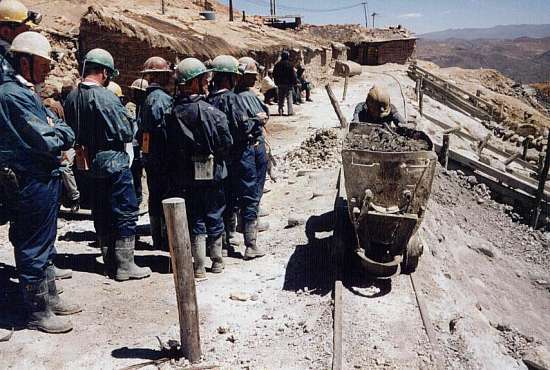
Afterwards we drive in a van up the mountain to the entrance of cooperative mine. There are also private mines here with a good organization, but because they use mostly machines, they need only a few people to work in rather good conditions. The other miners organized themselves in groups of 20, and dig by "good luck" throughout the mountain. They are paid for each lorry that gets filled up. On a normal day there are 7000 people in the mines. And although officially prohibited, 1000 of them are younger than 16 years. These children are the gofers. In total there are 500 mines, of which there are 120 active. The miners continue to work in poor circumstances because they can make the same money as a teacher, and much more than a carpenter etc.
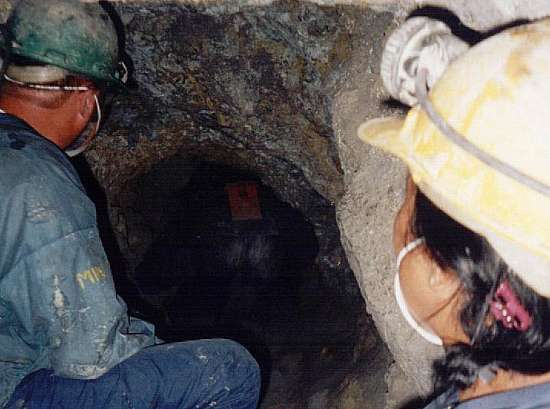
After this explanation from our guide we enter the mine in "battle order" (Juan first, Pedro at the back of the group). This path is not made for tall people (do the gooses walk), and even the smallest of the group must "mind there head" now and then. The path is not very wide, and there is much water on the ground. "Fortunately" you can hear a coal wagon coming from quite a distance, so that you can dive away in one of the niches.
The first stop is at "El Tio" (the devil). Here is a small museum, but in the beam of our head lights it looks all very weird. Thanks to Alma we can even make the usual sacrifice (cigarettes) to El Tio, so that we can do some wishes: a good turnover for the miners, a safe return for the group, and many tourists for our guides.
The path gets narrower, and in the meantime empty wagons (200kg) and full wagfons (800kg) keep passing by. They are pushed by two persons. At the end of path everyone if still in shape. This is the "point of no return": through a very (very) narrow shaft we descend 45m down: from level 1 to level 3. Here we see the miners in action: four of them push wagons of 2000kg. These are emptied at fixed places, and smaller wagons are used to pull the stone to level 1. Everybody who passes us, gets some coca leaves and a drink. These miners work 8u per day, only chewing on coca leaves. Eventually the path turns into (healthy) open air. Two hours in the mine, and our mouth masks are very dirty... miners work every day in this polluted air...
Outside Juan shows us how they use the dynamite. He just puts the wire into the bag of dynamite and puts it on fire. Pedro must ensure that it explodes at a safe distance.
After this adventure we return to change our cloths and take a shower. Willem then tells us that he changed the program for the salt lakes, so that we can see the symphonic orchestra. This is once in a lifetime event, organized in the framework of the culture week.
Again a quick snack and the three of us (with Britta) go to the Santa Teresa convent, for the 3pm tour. These time it's a Spanish guide, so Veerle must translate. The convent stores many valuable objects ancient and recent ones.
Then shopping for some bread (for the following travel days), and then we do eating in "Las Vegas". Again a simple restaurant. Here we are treated with 2 bottles Potosi lager. Seems fishy, but all ends well. Then a new e-mail to our friends, and the first week of our journey has passed away.
|